
Pioneer Memorial’s Black Adventist History Sabbath
Reckoning with Race: Pioneer Memorial’s Black Adventist History Sabbath
On Saturday, February 8, Pioneer Memorial Church (PMC) in Berrien Springs, Michigan, hosted a Black History Sabbath service that delivered more than just a celebration—it was a reckoning.
In his sermon, “To Preach the Gospel,” Ellen G. White Estate associate director Dwain N. Esmond challenged the Adventist community to confront its complex history with race. Rather than simply highlighting Black pioneers, Esmond’s message delved into the church’s struggles with segregation, injustice, and the gospel’s call to live out unity and equity. His message was not one of passive remembrance but of urgent responsibility, challenging the church to examine whether it has lived up to its founding principles.
“I’ve thought about telling you about Martin Luther King Jr., Malcolm X, and W.E.B. Du Bois,” Esmond said. “But I want to talk to you about one of my white heroes in Black history.” He introduced William Lewis Moore, a white postal worker and civil rights activist, who was assassinated in 1963 while delivering letters advocating racial justice in the South. Esmond used Moore’s story to illustrate that in Christ, true unity is not performative but sacrificial.
Esmond drew a stark contrast between the Advent movement’s early stance against slavery and its later reluctance to embrace racial equality fully. He cited pioneers like John N. Andrews and Uriah Smith, who openly condemned slavery in the 19th century. However, as the church expanded into the South, institutional racism took root, leading to policies that marginalized Black Adventists and restricted their participation in leadership and educational opportunities. This systemic exclusion set the stage for long-term racial inequities within the denomination.
One painful example was Lewis Sheafe, a gifted Black Adventist preacher who in 1903 founded the People’s Church in Washington, D.C.—the first predominantly Black urban Adventist congregation. Soon, its leadership forcibly divided the interracial congregation, setting a precedent for racial separation throughout the denomination. Sheafe’s departure reflected broader denominational tensions surrounding racial unity and justice, and pointed to a need for reconciliation and a renewed commitment to the gospel’s call for equality.
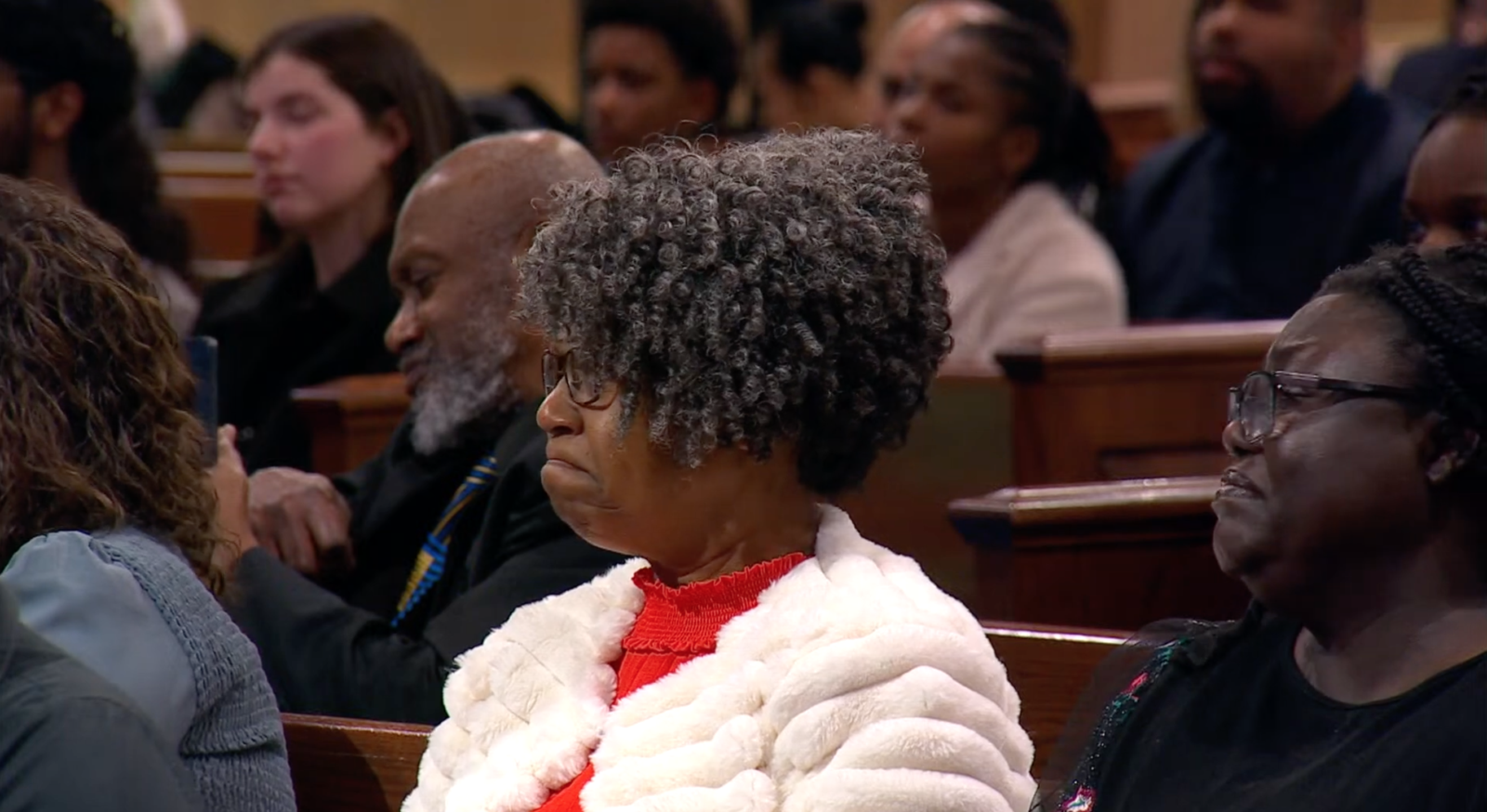
Audience members respond to Esmond’s preaching
In response to these injustices, in 1944, the Adventist Church established regional conferences as a structural solution to the systemic exclusion of Black Adventists. These conferences created leadership opportunities and autonomy in ministry, enabling self-governance and mission work. However, their very existence highlighted the church’s failure to fully integrate and embrace racial equality. Today, the conversation about how Adventism can move toward a more unified future that truly reflects the gospel’s vision of inclusion continues.
Tracing the path of early Black Adventist pioneers, Esmond demonstrated the contributions of Charles M. Kinney, the first Black ordained Adventist minister, who worked tirelessly to build churches despite facing systemic barriers. He spoke of evangelist E.E. Cleveland, who battled institutional resistance while working to bridge racial divides within the denomination. Esmond also shared the story of Edson White, son of Ellen White, who dedicated his life to spreading the Adventist message among formerly enslaved people in the South.
The gospel was never meant to be segregated, Esmond declared. “Our pioneers stood for truth and justice, not just in doctrine but in action. So why are we still hesitant today? Why do we still see divisions when Christ has called us to unity?”
His sermon took a deeply personal turn when he recounted the struggles of James Howard, a brilliant physician who rejected worldly success to join the Adventist movement, believing it held the answer to racial reconciliation. “They would ask him about his church, and he would tell them, ‘I’m in this church because this church has the cure for racism,’” Esmond told the congregation.
He did not dwell on condemnation but instead called for a renewed commitment to the principles of unity and justice. “Can you be what God has called you to be? Can you love like God does? Can you help those who are downcast? Can you raise up the oppressed?” he asked.
PMC’s response was palpable. Some nodded solemnly or shifted uncomfortably in their seats; others wiped away tears. But few could deny the weight of the moment. In his closing prayer, PMC lead pastor Shane Anderson acknowledged the necessity of courage and commitment: “If the world could look and see an example of what heaven will be like, what happens when people let the gospel go deep, what a difference it would make,” he said.
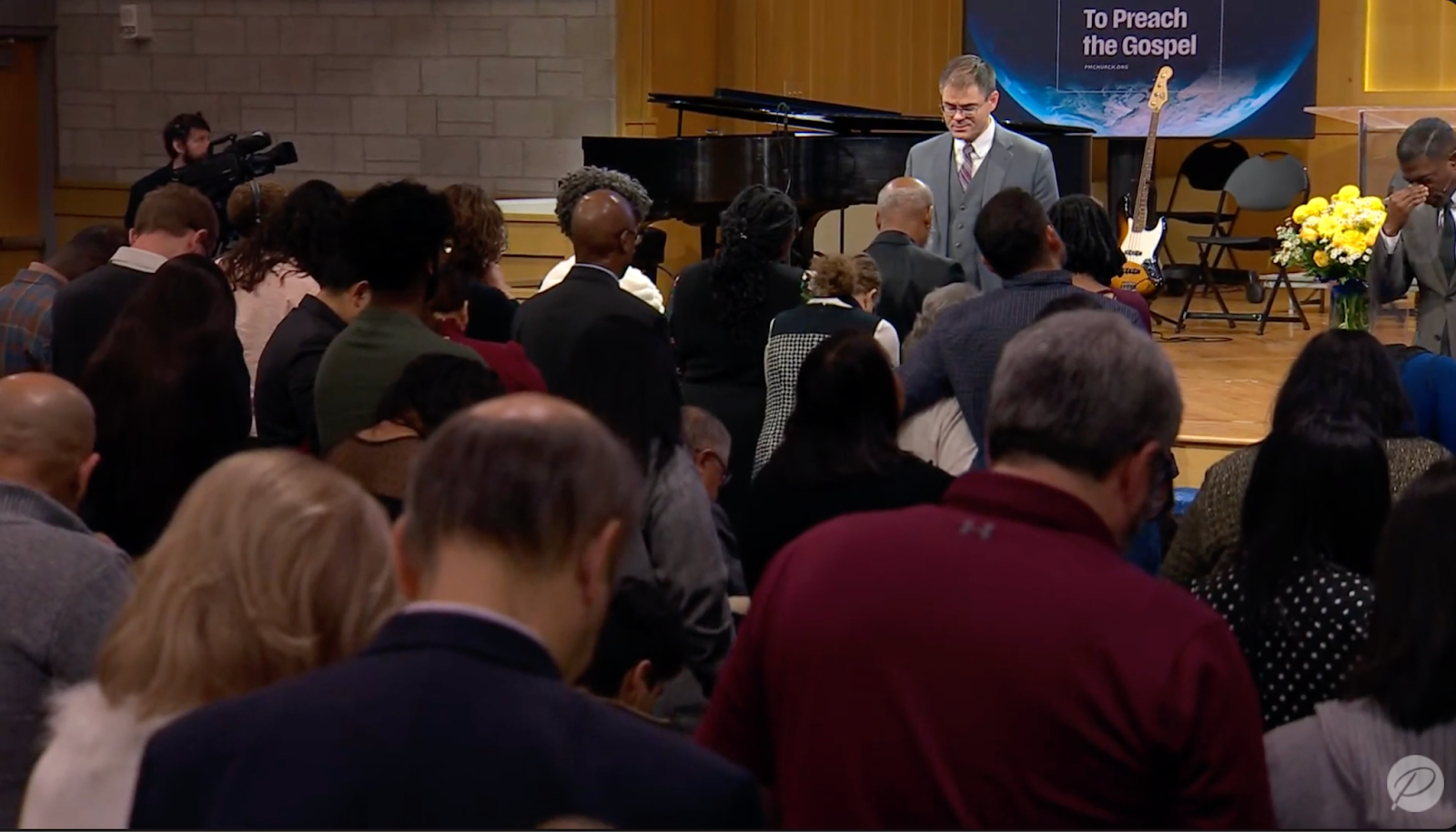
PMC lead pastor Shane Anderson leads prayer following the service.
The Black History Sabbath was not just an exercise in cultural appreciation; it was a challenge to Adventists to live out their faith in politically relevant ways. It confronted the historical amnesia that allows Adventism to overlook its own failures, and rejected the notion that issues of racial justice are separate from the gospel.
Whether an uncomfortable reminder of how far the church still has to go, or an affirmation of the hard work that remains, PMC’s Black History Sabbath sparked a necessary conversation. Esmond left the congregation with this final charge: “God gives us all the moments to get it right. This is our moment.”