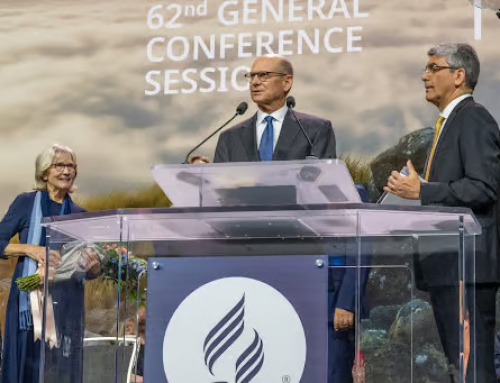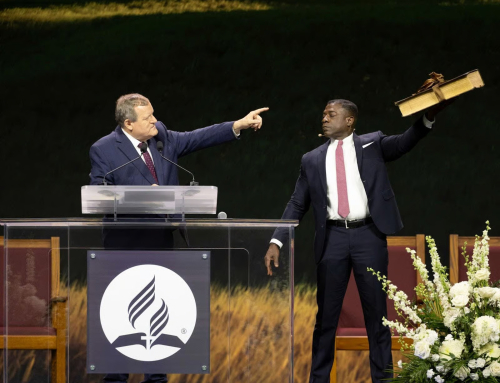

Session Chair Pierre Omeler
GC Session Delegates Consider, Reject Church Manual Changes
On July 7 in St. Louis, Missouri, General Conference (GC) Session delegates voted down two proposed revisions to the Church Manual. The first proposed change required churches to verify that transferring members are in harmony with Adventist fundamental beliefs. The second required pastors, head elders, and church board members to carefully consider changes to membership status—such as baptisms, transfers, and professions of faith—coming to a full consensus and seeking guidance from the local conference if the consensus could not be reached.
Originally, a single amendment combined both proposed changes, but Ingrid Wijngaarde, a delegate from the Netherlands Union, moved to split the two pages of the amendment so that they could be voted on separately. The motion passed.
When the floor opened for discussion of the first proposed revision, Glenda Augustine from the North England Conference spoke in favor of the amendment, suggesting that during the membership transfer process, churches should verify that members are living in accordance with Adventist doctrine. However, she raised concerns over how the church would equitably execute this change.
Gerson Santos, associate secretary of the GC, clarified that the GC Ministerial Association provides guidance for such matters.
“I believe that this is extremely important for us to consider,” said Santos. “However, the standards and understanding of procedures are so different for our church around the world. It’s not our goal here to have one standard that could be used anywhere in the world for that kind of matter; that’s why we have the ministerial association.”
Jaanus-Janari Kogerman, a delegate from the Baltic Union, spoke against the amendment because he believed it did not align with the church’s established policy rules.
“I speak against these motions because this creates an additional level of discipline in the church, which is not according to the Church Manual, as we know,” Kogerman said.
He then referred to page 69 of the Church Manual: “The authority to establish tests of membership rests with the General Conference Session. Anyone seeking to apply tests other than those herein set forth does not, therefore, properly represent the Church.”
Moreover, according to Kogerman, the revision to the second amendment, which would have added the pastor, head elder, and church board members to the membership consideration process—including head elders in membership evaluation—conflicted with the Church Manual “because the elders’ work is divided according to the spiritual gifts and talents.”
Later, Santos clarified that the head elder was included in the second amendment to help pastors manage their workloads. Afterward, he explained that lines 32 to 36 of the First Amendment did not introduce new discipline rules but rather gave local churches more authority over who may or may not be transferred.
After additional delegates spoke against the first amendment, GC delegate at-large Seth Woruba moved to end the debate and proceed to a vote using voting cards. His motion passed. The vote, done by raising voting cards, resulted in a majority against the first amendment. The session chair, Pierre Omeler, said he saw only about two people in favor.
“If you are in favor of the amendment, I invite you to raise your voting card now,” the Omeler said. “I see about two […] the motion fails the amendment.”
The floor then moved to the second proposed revision, which would require the pastor, head elder, and church board members to reach a complete agreement on various membership changes; otherwise, they would seek guidance from the local conference.
Norbert Zens, a delegate from the Inter-European Division, said he understood the intent but worried it might be misunderstood regarding who controls membership status. He argued that local churches should decide membership, not the conference.
“I believe this is not a good way to go, because the issue of membership, baptism transfer is an issue of the local church, and it stays there,” Zens said.
He warned that the local conference could be overloaded if membership issues were routinely escalated.
“I think the local church should, and has, to deal with that, and I think [if] it’s not, they can always seek counsel—that’s clear,” Zens said. “But now that it would be up to the conference to give guidance on that, I think that is not a good practice.”
He moved to delete lines 23 to 26, and the motion was approved.
Zens’ motion was supported by Sherrie Wendt, GC delegate at-large. She reasoned that local churches should have authority over membership changes, instead of the conference. Other delegates also spoke against these changes, and the board clarified that only the lines in question would be deleted.
Clinton Wahlen, a GC delegate at-large, said the reason for differing views on the amendment was due to confusion around its second sentence: “In the case that full consensus is not reached, the pastor, first elder, or the board should request guidance from the conference.” He then made a motion to separate the two sentences, deleting the second. After Omeler confirmed that the sentences could be split, the motion was put on the screen and delegates debated over whether that was the correct action to be taken.
Mandla Se-Bantwini Lupondwana, a delegate from the Southern Africa Union, spoke in favor of deleting the sentence because he believed that the local church should have final authority and responsibility for membership statuses. He tried to clarify the confusion the sentence caused. He stated that the original amendment introduced the concept of consensus, which conflicted with the church’s policy of majority vote. He did not think the creators of the amendment intended to change the requirement to consensus, he said, but voting to take out the word “consensus” would appear as though any one of the three—pastor, head elder, or board—could then seek local conference guidance on their own.
“The way it is now […] any one of the three could end up acting independently of the other,” Lupondwana said.
After further deliberations across the floor, Omeler requested that delegates refrain from repeating points already made. Steven Sep, a delegate from the Austrian Union, moved to end the discussion.
“Pastor, chair, I want to help you,” Sep said. “I call for the previous question. I move.”
The floor broke out in applause as Omeler said, “Amen.” Delegates voted to end the discussion, and Omeler then appealed for prompt action. He called for a vote by card on whether to remove the lines requiring full consensus and conference guidance. The motion failed, and the body then returned to the original amendment. Lupondwana called the question, which would cease all debate, and a vote would be taken; it was granted.
Due to confusion over which part of the amendment was being voted on, Wijngaarde asked for clarification. Omeler explained that they were voting on whether to remove all lines stating that the pastor, first elder, and church board should carefully consider membership changes, and that if no consensus was reached, they should seek conference guidance.
The final vote was 753 (62.4 percent) in favor, and 454 (33.6 percent) against—the lines were deleted. As the floor broke for lunch, the two proposed amendments had been voted down.